
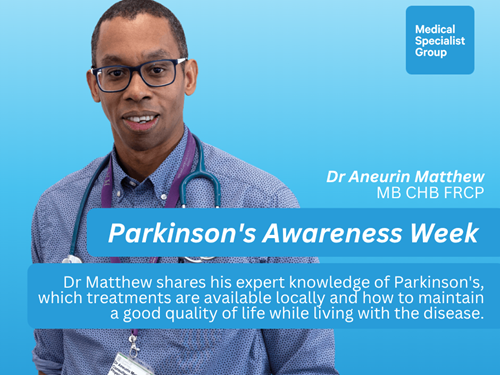
Parkinson's Awareness Week 2026
It’s Parkinson's Awareness week. Helping to raise awareness of the condition, Consultant physician Dr Aneurin Matthew gives us insight into the disease and shares his expert knowledge on local available treatments and how to best maintain quality of life.
What is Parkinson's?
Parkinson's is a progressive neurological condition which is caused by a loss of nerve cells in the part of the brain which refines movement. A lack of dopamine and other brain chemical affects motor symptoms (physical movement) and non-motor symptoms (such as emotions, sleep and sensory). Globally, Parkinson's is the fastest growing neurological disease.
What are the symptoms?
With the loss of nerve cells producing dopamine, symptoms of Parkinson's will begin to appear. For some people, they can take many years to show.
These are over 40 symptoms of Parkinson's, but the most common include tremors, slowness of movement, loss of balance and muscle stiffness. Pain, trouble sleeping, anxiety and depression are also symptoms associated with the condition.
These symptoms can make daily tasks difficult, affecting walking, dressing, writing and talking.
It’s important to remember that Parkinson's is a complex condition, and individuals can experience unique symptoms. Some symptoms may also take longer to progress in one individual to another.
Why are some people affected?
The reason why some people are affected by Parkinson's is still unknown, but it’s thought that it may be due a combination of age, genetics and environmental factors. We do know that most people diagnosed are over 50, and it’s slightly more prevalent in men than women.
There is significant research ongoing to identify the causes, with the hope to slow, stop or even reverse Parkinson's.
How many people are diagnosed with Parkinson's?
According to Parkinson's UK, 166,000 people in the UK live with Parkinson's, meaning that someone is diagnosed every 20 minutes. Locally, over 100 people have been diagnosed with the condition.
With an ageing population, these numbers are expected to rise. It’s also thought that many people are living with the condition unaware and unsupported, which is why raising awareness is vital.
What treatment is available?
While currently there is no cure for the disease, treatments are available which will help to maintain quality of life for as long as possible and reduce some symptoms. Although progression might not always slow down, it may become more manageable.
Most common treatments usually include -
- Medication to help reduce symptoms such as tremors and stiffness and improve functional movement. This is usually given by an injection, patches or orally.
- Physiotherapy to relieve joint pain and muscle stiffness through movement.
- Speech therapy to provide exercises to improve any speech or swallowing symptoms you may have.
- Occupational therapy to support you in everyday life and ensuring your home environment is safe, helping you to stay independent for longer.
Treatment is provided by our dedicated team of physicians, speech and language therapists, neurophysiotherapists, occupational therapists and a Parkinson’s nurse specialist. Medication is always reviewed regularly and in consideration of any changes to the patient’s need.
Does exercise help for Parkinson's?
Exercise is also considered very beneficial for those with Parkinson's and is the only proven treatment to slow down the progression of the disease.
Regular physical activity provides a positive impact both physically and mentally by improving strength, balance, stability and mood, and is more likely to improve your quality of life.
Activities can include walking, cycling, swimming, yoga or weight training.
The key to regular exercise is to maintain consistency, and Parkinson's UK recommend 2.5 hours a week to help manage and control symptoms.
If you’re thinking about a structured exercise programme, speak to a sports and exercise professional, including a neurophysiotherapist who can provide you with advice and an individualised approach tailored to the stage of the disease.
What support is available locally?
Parkinson's Guernsey is a great local charity that provides support to those with Parkinson's and their families and carers. They also hold regular activities such as walking football, boxing and pickleball as well as social events like coffee mornings to help those people connect with others in a similar situation. Regular social interaction can help greatly by improving your emotional well-being.
What should I do if I'm experiencing any of these symptoms?
If you or someone you know is experiencing any of the above-mentioned symptoms, be sure to seek medical attention as soon as possible. The earlier you are diagnosed the better, as it may significantly improve your quality of life.
Visit your GP who will take a detailed medical history and physical examination. If they believe your symptoms may be associated with Parkinson's, they’ll refer you to the Medical Specialist Group.
Where can I find more information?
Parkinson's Guernsey and Parkinson's UK are great resources which are available to anyone online. They provide useful information on Parkinson's as well as support.
Help us spread awareness
Please help us spread awareness of Parkinson's so we can reach those in our community who might be feeling unsupported and show them that they’re not alone.
Sharing information is vital so we can ensure people have the right advice and support to receive a timely diagnosis and help them achieve the best quality of life possible.